
Carbon-Aware Pricing: The Next Frontier in Commodity Intelligence
How carbon intensity, production economics and regulation are reshaping commodity price discovery, procurement and trade.
Commodity prices have long been explained by a familiar set of forces: supply and demand, production cost, freight, trade flows, inventories, macroeconomics and geopolitics. Those fundamentals still matter but a new variable is increasingly entering the pricing equation: carbon.
As carbon pricing schemes expand, border-adjustment regulation takes effect and buyers scrutinize supply-chain emissions, carbon is shifting from a sustainability or compliance metric toward a genuine commercial variable - one that shapes production economics, competitiveness, landed cost, supplier selection, trade flows, procurement outcomes, margins and investment decisions. For procurement leaders, traders, manufacturers and strategy teams, understanding this shift is becoming as material as understanding freight or currency.
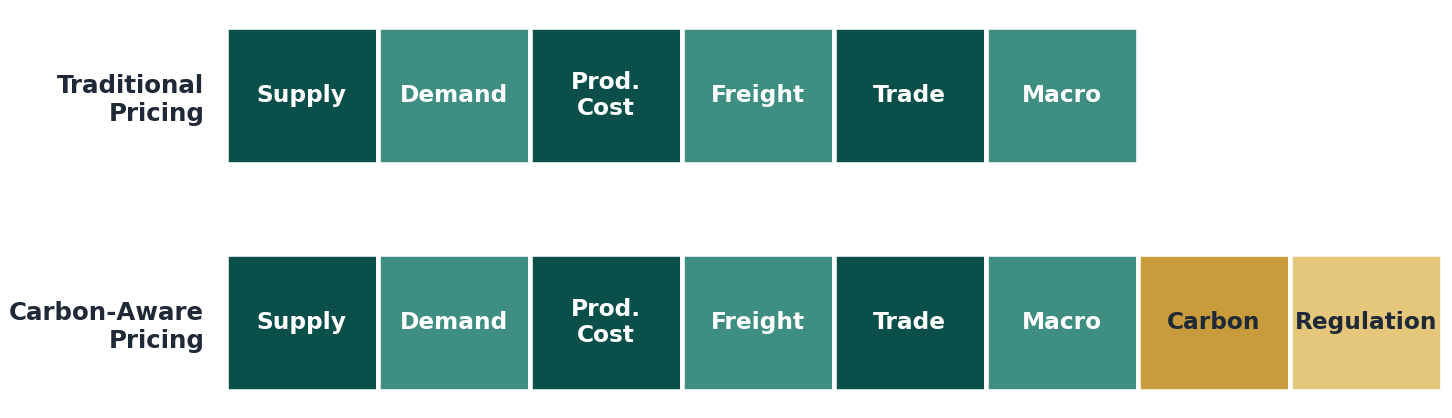
Chart 1. Traditional Commodity Economics vs Carbon-Aware Commodity Economics - carbon and regulation join the pricing equation as additional factors, not replacements.
Carbon is becoming an additional commodity pricing variable alongside supply, demand, cost, freight and macro conditions - not a replacement for them.
Two physically identical tonnes of steel, aluminium or ammonia can carry very different carbon-adjusted economics depending on production route, energy source, geography and regulatory exposure.
CBAM is one well-defined example within carbon-aware pricing, not a synonym for it. Its definitive regime applies from 1 January 2026 and covers cement, iron and steel, aluminium, fertilizers, electricity and hydrogen.
The supplier with the lowest FOB price does not necessarily offer the lowest carbon-adjusted delivered cost once carbon and regulatory exposure are added.
Carbon-aware forecasting works best across Low, Base and High carbon-cost scenarios - a range of plausible economics rather than false precision.
Carbon-aware pricing, defined
Carbon-aware pricing is the integration of carbon intensity, carbon costs, production pathways and carbon-related regulation into commodity price and cost analysis.
Carbon-aware pricing is broader than simply adding a carbon tax line to a price. Depending on the commodity and market, it can incorporate carbon intensity, carbon price, production pathway, energy source and electricity mix, embedded emissions, carbon-related regulation and CBAM exposure, low-carbon production premiums, supplier-specific emissions data, and relevant logistics or value-chain emissions.
Two physically similar units of a commodity - a tonne of steel, aluminium or ammonia - can carry very different carbon-adjusted economics depending on production technology, feedstock, energy source, geography and regulatory exposure. That difference is what carbon-aware pricing sets out to make visible and comparable.
Structural forces pushing carbon into commodity economics
Several structural forces are pushing carbon into commodity economics: the expansion of carbon-pricing schemes; carbon border adjustment mechanisms; decarbonization requirements placed on producers; emerging low-carbon product premiums; customer procurement requirements; mandatory supply-chain emissions reporting; and growing differentiation between high- and low-carbon production routes for the same commodity.
The EU's Carbon Border Adjustment Mechanism (CBAM) illustrates the shift concretely. Its definitive regime applies from 1 January 2026 and currently covers cement, iron and steel, aluminium, fertilizers, electricity and hydrogen - not all commodities. CBAM is one specific regulatory mechanism that creates a direct carbon-related cost for certain EU imports; carbon-aware pricing is the broader analytical concept, and CBAM is best understood as one current, well-defined example within it, not a synonym for it.
Source: European Commission, Taxation and Customs Union.
Carbon relevance across commodity markets
Carbon relevance varies significantly across commodity markets, and extends well beyond the sectors directly covered by CBAM today.
Table 1. Carbon Relevance Across Selected Commodity Markets - qualitative assessment, illustrative and not exhaustive.
Extending the landed-cost framework
Traditional commodity procurement builds landed cost from FOB price, freight and tariff. Carbon-aware procurement extends that framework to add carbon cost and regulatory exposure, producing what can be called a carbon-adjusted delivered cost.
The implication matters commercially: the supplier with the lowest FOB price does not necessarily offer the lowest carbon-adjusted delivered cost once carbon and regulatory exposure are added. This framework is conceptual and illustrative - actual figures depend on route, product, counterparty and applicable regulation.
When a higher-cost supplier becomes more competitive
The chart below illustrates the concept: a supplier with a higher underlying production cost can become more competitive once carbon costs are incorporated into the comparison.
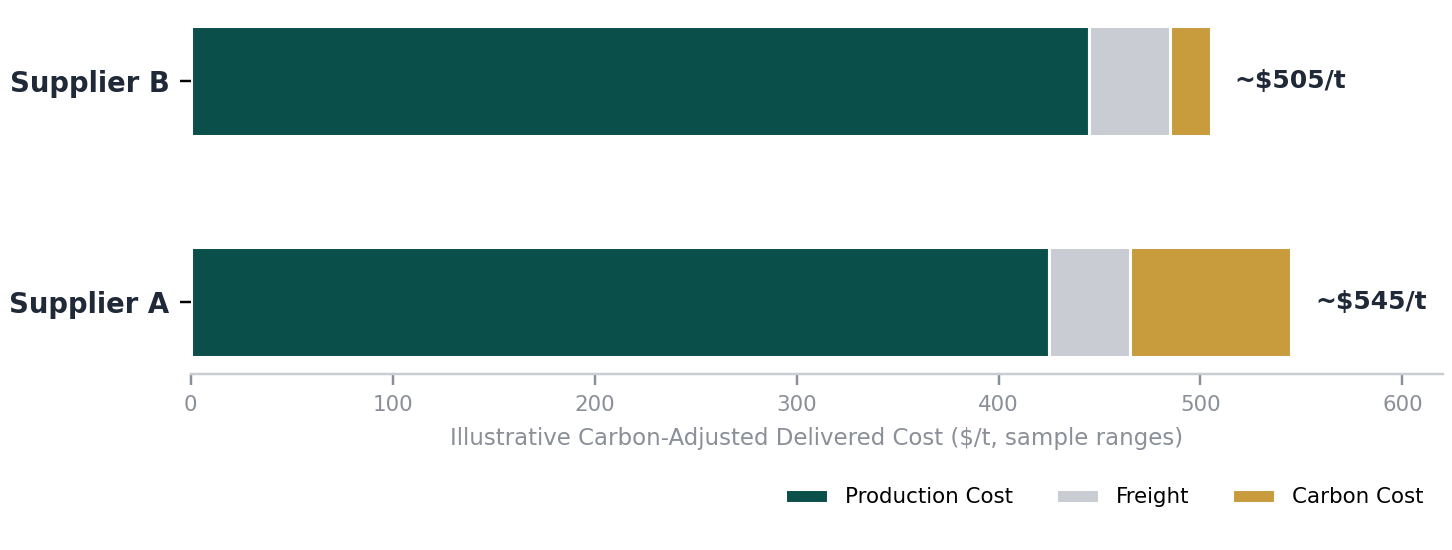
Chart 2. Data shown are sample and illustrative, intended only to demonstrate the carbon-adjusted cost concept and are not representative of actual supplier economics.
From lowest price to lowest carbon-adjusted cost
Traditional procurement asks: "Who offers the lowest price?" Carbon-aware procurement asks a different question: "Who offers the lowest carbon-adjusted delivered cost and risk?" It weighs supplier comparison, carbon intensity, FOB/CFR economics, freight, tariffs, CBAM exposure, carbon-price scenarios, production pathways, low-carbon premiums, contract structure and supply-chain risk - and it does not automatically mean choosing the lowest-carbon supplier. The objective is to understand the trade-off between price, carbon, regulation, risk and supply security.
Table 2. Traditional Procurement vs Carbon-Aware Procurement.
A further term in the arbitrage calculation
Carbon can also influence commodity arbitrage and trade. Traditional arbitrage nets a regional price differential against freight and transaction costs; carbon-aware arbitrage subtracts a further carbon or regulatory cost term. That additional term can shift export competitiveness, regional trade flows, supplier selection, import and export parity levels, regional price spreads, and the size of low-carbon premiums - effects that are directional rather than precisely quantifiable today.
Scenarios, not single-point estimates
Traditional forecasts model commodity price as a function of supply, demand, cost, freight and macro conditions. Carbon-aware forecasting adds carbon and regulation as explicit inputs - carbon prices, carbon intensity, production technology, energy mix, regulatory scenarios, CBAM exposure and carbon-cost sensitivity - typically framed across Low, Base and High carbon-cost scenarios rather than a single-point estimate. This gives decision-makers a range of plausible future economics rather than false precision.
A chain-wide, not point-in-time, exercise
Carbon-aware intelligence is most useful when it spans the full value chain, from feedstock through to the customer, rather than a single commodity price point.
At each stage, economics can be affected by carbon intensity, energy source, production pathway, carbon price, freight and regulation - which is why carbon-aware analysis works best as a chain-wide, not point-in-time, exercise.
An additional variable, not a replacement
Carbon's commercial role is evolving in stages: today, largely a sustainability or compliance metric; emerging, a cost variable; next, a procurement variable; and increasingly, a commodity pricing variable in its own right. Commodity intelligence will need to combine prices, supply-demand, production economics, freight, trade, carbon, regulation, macroeconomics and geopolitics - carbon is becoming an additional variable alongside these traditional drivers, not a replacement for them.
The next generation of commodity intelligence will not simply answer "What is the price?" It will increasingly need to answer "What is the economic cost of this commodity after carbon, freight, trade policy and regulatory exposure are considered?"
EnviroSusIQ. (2026). Carbon-Aware Commodity Prices: analytical framework. EnviroSus Consultancy.
European Commission. (2026). Carbon Border Adjustment Mechanism (CBAM). Directorate-General for Taxation and Customs Union.
European Union. (2023). Regulation (EU) 2023/956 establishing a carbon border adjustment mechanism. Official Journal of the European Union.
Methodology note: frameworks, cost stacks and cost-curve figures in this article are conceptual and illustrative. They demonstrate analytical structure rather than actual supplier economics, and do not constitute market-price quotations or forecasts. Actual figures depend on route, product, counterparty and applicable regulation.
Research built for carbon-aware commodity decisions
ESIQ is a next-generation research and advisory firm operating at the intersection of business intelligence, sustainability and disruptive technology. As a boutique research firm, ESIQ combines deep domain expertise, rigorous methodology and a customer-first, brief-led approach across decarbonization, energy transition, low-carbon markets, deep technology and related industrial sectors - delivered through databases and dashboards, bespoke research, and primary voice-of-customer research.
Used well, carbon-aware commodity intelligence can help decision-makers gauge the impact of carbon costs on commodity economics, compare suppliers and production pathways, assess carbon-related trade exposure, and evaluate future cost scenarios - supporting more informed procurement and margin-protection decisions, without guaranteeing specific savings or forecast outcomes.
Carbon-Aware Commodity Pricing
Integrating carbon intensity, carbon price and production pathway into commodity price and cost analysis.
Carbon-Adjusted Landed-Cost Analysis
Building delivered cost from FOB price, freight, tariff, carbon cost and regulatory exposure.
Supplier & Origin Comparison
Carbon-intensity benchmarking across suppliers, production routes, energy sources and geographies.
CBAM-Related Commodity Intelligence
Coverage assessment, embedded-emissions basis and regulatory exposure for affected commodity flows.
Carbon-Cost Scenarios
Low, Base and High carbon-cost sensitivity analysis rather than single-point price estimates.
Export-Competitiveness Analysis
Trade-flow, parity and regional-spread assessment as carbon and regulation shift origin competitiveness.
Navigating carbon-aware commodity markets?
ESIQ partners with producers, buyers and traders to turn carbon-aware pricing signals into decision-grade procurement and market strategy.
Continue the research
Reshaping Global Fertilizer Trade Under Carbon Border Adjustments
How the EU's Carbon Border Adjustment Mechanism is set to redraw sourcing, pricing and competitiveness across global nitrogen and phosphate fertilizer trade.
Read More →
Marine Shipping Decarbonisation
Navigating the transition to low-carbon shipping - the regulations, fuels, infrastructure and freight economics reshaping global trade.
Read More →