
The Battery Fix
How battery storage is solving the energy transition’s real bottleneck.
Authored by Nikhil Charbai
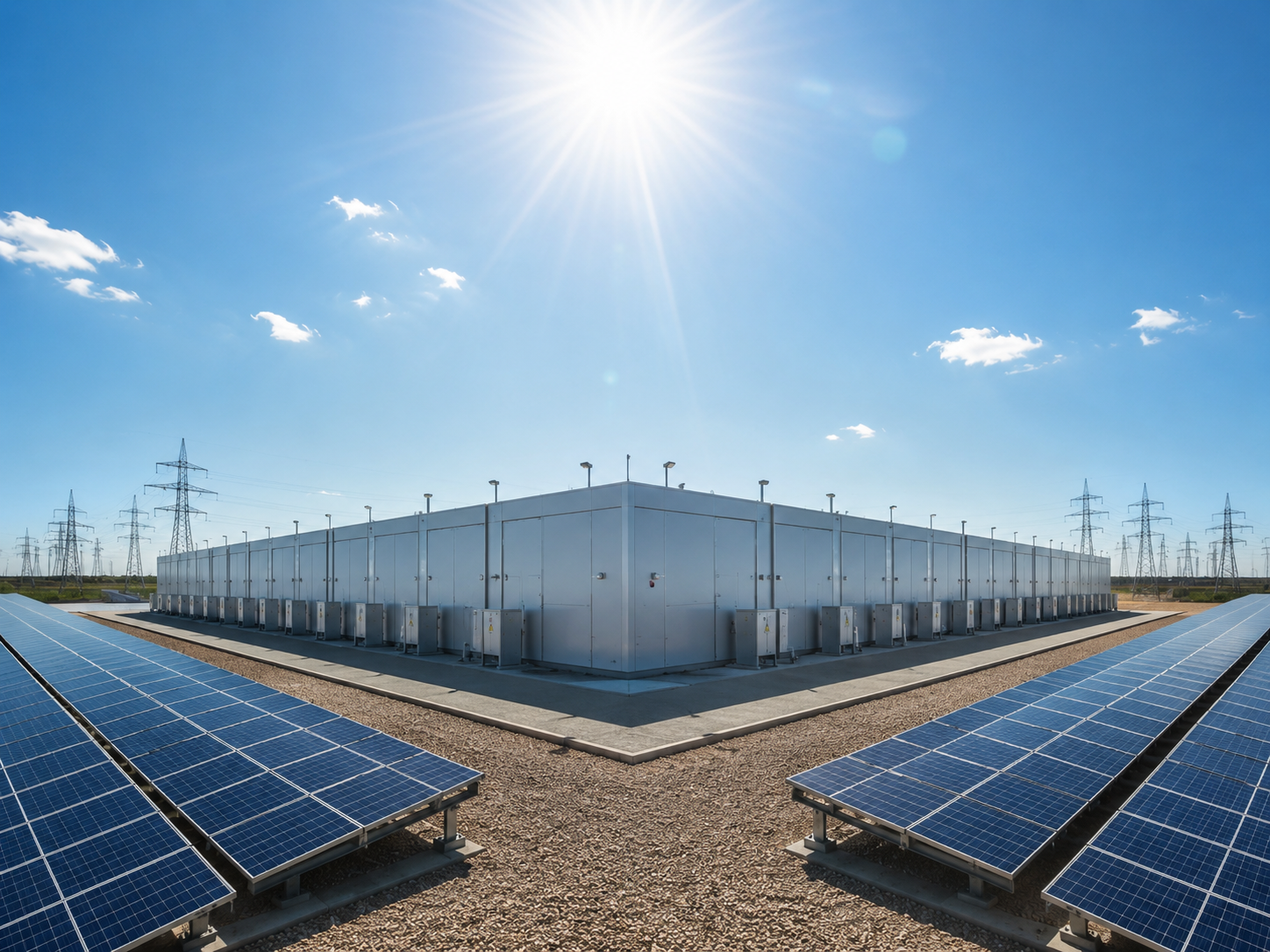
For most of the last century, keeping an electricity grid stable was a job handled almost invisibly by giant spinning machines. Coal, gas, and nuclear turbines didn’t just make electricity – their sheer rotating mass acted as a shock absorber, smoothing out the constant, tiny mismatches between supply and demand that would otherwise send voltage and frequency spiralling out of control. That physical inertia was the grid’s unspoken insurance policy.
That insurance policy is now being retired, plant by plant, faster than most grids can replace it. In its place, a new kind of infrastructure – the battery energy storage system, or BESS – has moved from a supporting technology to a foundational one. Understanding why requires looking past the “battery” part of the name and toward what these systems actually do for a modern, renewable-heavy grid.
Market at a glance
Five takeaways for the grid transition
Grid stability, not clean-power generation, has become the central bottleneck of the energy transition – inertia-providing plants are retiring faster than replacements arrive.
The consequential shift is from grid-following to grid-forming BESS, which establishes its own voltage and frequency reference and manufactures synthetic inertia.
Scale is not stability: GWh measures how much energy a battery can move, not whether it provides grid-forming services. Procurement specification and market design decide that.
Regulators have moved fast – AEMO, ENTSO-E, IEEE 2800, Germany's inertia procurement and the UK's Stability Pathfinder now pull the market toward grid-forming designs.
The economics have caught up: total BESS costs are down roughly 55% since 2019, with AC-block hardware below $100/kWh in early 2026.
Wind and solar are, by nature, intermittent and electronically interfaced – they connect to the grid through inverters rather than spinning directly with it. That makes them clean and increasingly cheap, but it also means they contribute little or none of the natural inertia that used to keep grids stable by default. As Wood Mackenzie has noted, this loss of inertia and the inherent variability of renewable output make it risky for wind and solar to be a grid’s sole power source without something else picking up the stabilising role.
The scale of the challenge is what makes it urgent. Ember Energy’s tracking shows the world added 793 GW of renewable capacity in 2025 alone – up 11% from 717 GW in 2024, and building on growth of 22% in 2023 and 66% in 2022. That pace needs to keep climbing: the COP28 pledge to triple global renewable capacity by 2030, which the IEA and IRENA both treat as the minimum required for a 1.5°C pathway, means going from roughly 3.4 TW installed in 2022 to around 11,000 GW by 2030. Every gigawatt of that build-out displaces a bit more of the conventional generation that used to hold the system together – which means grid stability has quietly become one of the central bottlenecks of the entire energy transition, not a side issue for engineers to solve later.
The storage side of that equation is already visible in the data too. Ember’s Global Electricity Review 2026 found that the world installed enough battery capacity in 2025 to shift 14% of that year’s new solar generation from midday into other hours of the day – and front-runners like Chile and Australia installed enough grid-level storage to shift over half of their new solar generation, already seeing the benefits in lower curtailment. Storage isn’t a future add-on to the renewables build-out; it’s already being deployed in lockstep with it, just not yet fast enough everywhere.
This isn’t a future hypothetical – it’s already showing up in the data. McKinsey research found that German grid operators were forced to curtail around 9.4 terawatt-hours of renewable power in 2024 alone, simply because transmission bottlenecks and distribution capacity issues couldn’t absorb it. Chile, China, Great Britain, and Ireland are seeing similar patterns. Clean power is increasingly available; the constraint is the grid’s ability to handle it safely.
This is where BESS earns its “essential infrastructure” label. In its simplest form, battery storage is thought of as a time-shifting tool – storing cheap solar power at midday and releasing it in the evening peak. That function matters, but it’s not what makes storage indispensable to grid stability. The more consequential shift is the move from grid-following to grid-forming battery technology.
A grid-following inverter behaves like a passenger: it senses the grid’s existing voltage and frequency and synchronises to it, injecting power in step with a signal set by someone else. That works fine on a strong grid dominated by conventional generators. It breaks down as those generators disappear, because there’s an ever-thinner signal left to follow.
A grid-forming BESS behaves differently. Rather than following an existing waveform, it behaves like a voltage source – establishing its own voltage and frequency reference and responding dynamically to system conditions, effectively manufacturing synthetic inertia rather than relying on someone else’s. Wood Mackenzie describes this as BESS providing “highly flexible and responsive grid inertia that can support or replace the conventional synchronous generators of traditional power systems.” In practical terms, a grid-forming battery can inject power within milliseconds of a frequency disturbance, ride through faults that would trip older equipment offline, and even black-start a dead section of grid without help from anywhere else – something no ordinary battery, and no wind or solar farm, can do on its own.
Table 1. Grid-following versus grid-forming inverter behaviour.
That last row matters more than it might seem. Grid-forming does not automatically mean “better” – it means “built for a different job.” A BESS sitting on a strong grid, doing straightforward energy arbitrage, can be perfectly well served by a well-designed grid-following system at lower cost and complexity. It’s when the system faces high renewable penetration, weak-grid conditions, microgrid operation, or islanding requirements that grid-forming stops being a nice-to-have and becomes the only design that actually works. The right question for a developer isn’t “which inverter is better” – it’s “does this BESS need to follow the grid, or help build it?”
The industry’s biggest headline-grabbers make this distinction concrete. The world’s largest BESS projects are now measured in multi-gigawatt-hour blocks – Masdar and EWEC’s 19 GWh “round-the-clock” project in Abu Dhabi, Saudi Electricity Company’s 12.5+ GWh BYD program, and Australia’s Collie Battery, among others. But scale alone doesn’t tell you whether a project is actually built for grid stability, and the three fall into genuinely different categories.
GWh measures how much energy a battery can move, not whether it’s providing grid-forming stability services. That comes down to procurement requirements and market design, not scale. A 2 GWh project built to a stability spec can do more for grid resilience than a 19 GWh project built for baseload delivery.
Grid-forming capability has moved from an academic curiosity to a hard procurement requirement in the space of only a few years, driven by grids that have already run into trouble. Weak-grid instability tied to high inverter penetration has already surfaced in places like South Australia, Texas’s ERCOT market, the UK, and Ireland, giving system operators direct evidence that grid-following resources alone can’t be trusted at scale.
Regulators have responded accordingly. Australia’s AEMO now requires new large-scale battery projects in weak grid zones to be grid-forming. Europe’s ENTSO-E network code is moving toward mandating grid-forming behaviour for new inverter-based resources above 1 MW. North America’s IEEE 2800 standard, originally written with grid-following technology in mind, has been revised to strongly favour grid-forming designs wherever grid strength is low. Germany has launched a dedicated inertia procurement scheme, and the UK’s Stability Pathfinder programme has been paying premiums for stability services since some of its earliest tender rounds. India’s regulator, the CERC, has signalled similar requirements are coming.
The market is already responding to that signal. By some industry estimates, more than 70% of the global BESS project pipeline in 2026 specifies grid-forming inverter technology, up from a niche minority just a few years earlier.
Even with that momentum, the numbers suggest the industry is behind, not ahead. Wood Mackenzie projects that BESS will be the second-largest source of new power capacity across Europe, the United States, and Asia-Pacific over the coming decade – with new capacity additions in Asia-Pacific alone running at nearly five times the pace of either Europe or the US. By 2034, cumulative new BESS installations globally are expected to reach around 1,500 GW, overtaking cumulative new wind power additions.
Yet Wood Mackenzie’s own modelling suggests that even in an optimistic scenario where every future battery deployment is grid-forming, the world would still need roughly 1,400 GW of additional storage capacity over the next decade purely to keep pace with the stability demands created by renewables growth. In other words, this isn’t a technology that merely helps the transition along – the transition mathematically cannot happen at the pace currently planned without it.
McKinsey’s own modelling reaches a similarly bullish conclusion from a different angle. Across three distinct future scenarios – ranging from a slow, energy-independence-focused path to an ambitious decarbonisation trajectory – installed BESS capacity is projected to grow by roughly 50% a year from 2022 through 2030. The fact that the growth rate barely changes across such different policy and market assumptions is telling: this isn’t a bet on one particular version of the future, it’s infrastructure the grid needs regardless of how the transition unfolds. McKinsey values the global BESS market at $120–150 billion by 2030.
The stability argument for BESS would matter even if it cost more than the alternatives, but increasingly it doesn’t. Hybrid utility-scale solar-plus-storage projects are already cost-competitive with onshore wind in many markets. Wood Mackenzie estimates that, outside the United States, utility-scale battery storage will undercut the cost of coal and gas generation by 2040. McKinsey’s cost data backs up the trend: total BESS costs have fallen roughly 55% since 2019, and hardware pricing for AC blocks dropped below $100 per kilowatt-hour in early 2026, with some Chinese system quotes as low as $65/kWh. That combination – a technology the grid structurally needs, arriving at a cost point that beats the incumbents it’s replacing – is what has turned BESS from an optional add-on into core grid infrastructure in investment and policy conversations alike.
The modern grid’s central challenge isn’t generating enough clean electricity – most credible forecasts suggest that part is achievable. It’s keeping that electricity stable once conventional, inertia-providing generation retires faster than replacements arrive. Battery storage, and specifically grid-forming battery storage, is the technology best positioned to close that gap: fast enough to react in milliseconds, flexible enough to be sited almost anywhere, and increasingly cheap enough to deploy at the scale the transition demands. The trillion-dollar renewable build-out underway globally will only deliver a stable grid if storage keeps pace with it – which is precisely why BESS has stopped being a nice-to-have and become essential infrastructure.
The right question for a developer isn’t “which inverter is better” – it’s “does this BESS need to follow the grid, or help build it?”
This is part of ESIQ’s ongoing coverage of the low-carbon and new energies transition – tracking the technologies, policies, and capital flows reshaping the grid. Follow along for more research-led perspectives on decarbonization and deep technology.
Ember Energy. (2026). Global Electricity Review 2026.
Ember Energy. (2025, November). Renewable additions in 2025 are once again expected to surge.
Wood Mackenzie. (2025, July). Steadying the grid: why grid forming BESS technology is crucial to future renewable energy supply.
McKinsey & Company. (2026, March). Powering the future: Strategies for battery energy storage developers.
Reporting on the Masdar/EWEC RTC, SEC/BYD Saudi Arabia, and Collie Battery (Australia) projects.
Industry analysis on grid-forming inverter standards and deployment trends (IEEE 2800, ENTSO-E, AEMO, UK Stability Pathfinder, 2026).
Research built for grid-storage decisions
ESIQ provides bespoke intelligence, market mapping, project tracking and voice-of-customer research for organisations navigating the battery-storage and grid-flexibility landscape – whether as developers, investors, technology providers, utilities or regulators.
BESS Market Sizing & Outlook
Capacity and value forecasting across regions and applications, with scenario ranges rather than single-point estimates.
Project Pipeline Intelligence
Tracking announced, awarded, under-construction and commissioned projects, including grid-forming specification share.
Grid-Stability & Flexibility Analysis
Inertia requirements, weak-grid exposure, curtailment patterns and the case for grid-forming versus grid-following designs.
Market Design & Revenue Stacking
How ancillary-service, capacity and energy markets pay for system strength – and where stability services remain uncompensated.
Cost & Competitiveness Benchmarking
AC-block and system pricing trends, hybrid solar-plus-storage economics and comparison against thermal generation.
Regulatory & Standards Tracking
Monitoring AEMO, ENTSO-E, IEEE 2800, CERC and national inertia-procurement schemes as requirements tighten.
Tracking the battery storage market?
ESIQ partners with developers, investors, technology providers and policymakers to turn energy-transition signals into decision-ready market intelligence.
Continue the research
From Ambition to Market Reality: Where Could India's Green Hydrogen Opportunity Emerge?
A scenario-based view of India's green hydrogen opportunity across demand, supply, sector adoption and the emerging market gap.
Read More →
Cement Decarbonisation & Green Cement Solutions
The levers, technologies and economics reshaping one of the world's hardest-to-abate industrial sectors — and the commercial case for low-carbon construction.
Read More →
Marine Shipping Decarbonisation
Navigating the transition to low-carbon shipping — the regulations, fuels, infrastructure and freight economics reshaping global trade.
Read More →