Fertilizer price forecasting shapes decisions worth far more than the forecast itself. Producers use it to plan production and procurement; traders use it to time markets and select destinations; importers and distributors use it to manage landed cost and inventory; and senior management uses it to budget, plan scenarios and protect margin. Getting the forecast wrong is not a rounding error — it changes what a business buys, makes and sells.
Fertilizer prices are shaped by a chain running from energy and raw materials through production, supply, demand, trade and policy and that chain rarely moves in a straight line. In the first quarter of 2026, the World Bank's fertilizer price index rose more than 12% quarter-on-quarter as disruptions around the Strait of Hormuz tightened global supply and pushed urea prices sharply higher, illustrating how quickly assumptions behind a forecast can stop holding. This article examines whether AI can predict better fertilizer prices than traditional models, and where a hybrid approach can add value.
Fertilizer prices sit at the intersection of energy, supply, demand, logistics and geopolitics.
Traditional models remain sound, but changing conditions erode the historical relationships they depend on.
AI can potentially process a broader range of signals and help surface interactions traditional models miss — within real limits.
The strongest forecasting approach combines fundamentals, AI/ML and human judgement, not one in place of the others.
Fertilizer forecasting has never relied on a single model. It combines several complementary lenses: production-cost and energy/feedstock economics; supply-demand analysis covering capacity, utilization, inventories and trade flows; import-parity and export-netback analysis, which accounts for freight, duties and port charges; econometric and time-series models that project historical relationships forward; and scenario analysis that stress-tests these views against shocks. Used together, this playbook gives management the economic logic behind a number, not just the number itself.
Figure 1 — Fertilizer Price Formation Framework: the chain from feedstocks to price outlook.
Table 1.Traditional Fertilizer Price Models and Their Challenges.
These are best understood as potential modelling risks — not defects present in every model or every forecast:
Over-reliance on historical relationships
Ignoring nonlinear interactions between drivers
Incorrect or shifting seasonality assumptions
Ignoring structural breaks in market conditions
Disconnect between forecasts and commercial decisions
A fertilizer price looks like a single number, but the economics behind it are not simple. Nitrogen fertilizers illustrate this well: ammonia, the starting point for mineral nitrogen fertilizers, is energy-intensive, and a substantial majority of global ammonia production runs on natural-gas-based steam reforming, so natural-gas prices move nitrogen economics directly. Layered on top of production cost are supply, inventories, trade flows and farmer demand, which itself tracks crop prices — and a single shock, such as a shipping disruption, can move several of these variables at once.
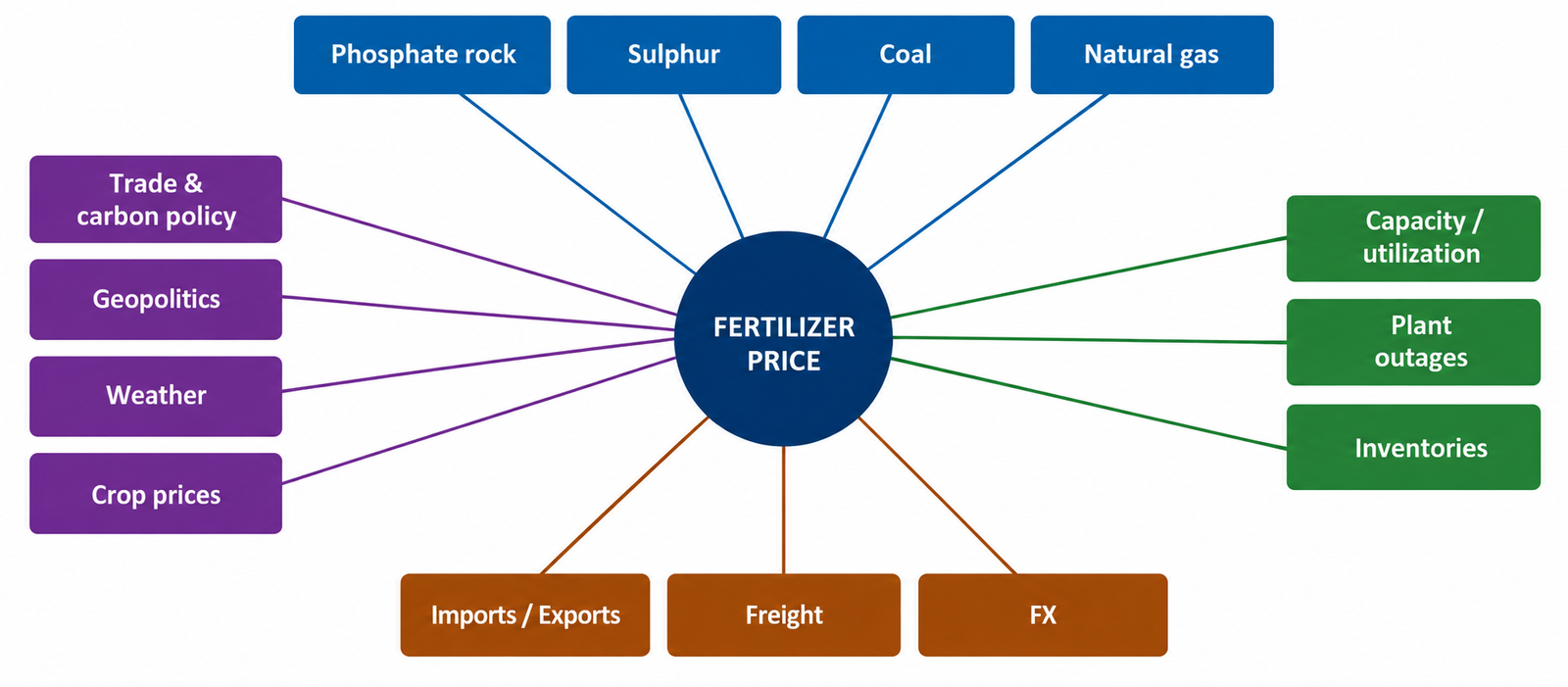
Figure 2 — Fertilizer Price Complexity Map: interacting drivers behind a single price.
Wider data processing
A forecasting system can combine historical fertilizer prices with energy and freight indicators, exchange rates, inventories, trade data, weather, crop prices, news and policy signals processing more simultaneous signals than a traditional model typically specifies in advance.
Nonlinear relationship detection & pattern recognition
Machine-learning models can potentially learn how signals interact rather than requiring each interaction to be specified up front, and may help identify changing correlations, anomalies, regime changes and early-warning signals moving forecasting from a static output toward a continuously updated one. AI does not always improve accuracy: it depends heavily on data quality, model design and how unprecedented the underlying shock is.
Table 2.Short-Term vs. Long-Term AI Forecasting Horizons.
This is the article's central argument: AI should augment economic forecasting rather than replace it. Market data feeds a fundamental model built on cost curves, supply-demand balances, capacity and trade economics; an AI/ML layer adds pattern recognition, nonlinear relationships and dynamic updating; a scenario engine translates this into base, downside and upside cases; and expert validation converts the output into a decision-ready outlook.
Figure 3 — Hybrid AI + Fundamental Forecasting Architecture.
Carbon regulation adds another dimension to fertilizer economics — carbon intensity, embedded emissions, carbon cost, regional production economics and supplier selection all now factor into trade competitiveness. CBAM does not make AI automatically more accurate; it increases the number of variables and interactions that a fertilizer forecasting system may need to monitor.
Table 3.Implications for Fertilizer Industry Stakeholders.
The more useful question is not simply “What will the fertilizer price be?” but “What is changing, why is it changing, how confident are we, and what should management do?” In a volatile fertilizer market, the advantage will belong to the company that recognizes change first combining fundamentals, AI and human judgement rather than relying on any one alone.
International Energy Agency (IEA). (2021). Ammonia Technology Roadmap: Towards more sustainable nitrogen fertiliser production. IEA, Paris.
World Bank. (2026). Fertilizer prices surge as Strait of Hormuz disruptions tighten supplies. World Bank Data Blog, May 14, 2026.
Williams, A., Collins, L. A., & Boline, A. (2025). Drivers of Fertilizer Markets: Supply, Demand, and Prices (ERR No. 354). USDA Economic Research Service.
USDA Economic Research Service. (2025). Fertilizer Use and Price: Summary of Findings.
Manogna, R. L., Dharmaji, V., & Sarang, S. (2025). Enhancing agricultural commodity price forecasting with deep learning. Scientific Reports, 15, 20903.
Nayak, G. H. H., Alam, M. W., Singh, K. N., et al. (2024). Exogenous variable driven deep learning models for improved price forecasting of top crops in India. Scientific Reports, 14, 17203.
International Fertilizer Association (IFA). IFASTAT — Global Fertilizer Statistics and Market Data.
Food and Agriculture Organization of the United Nations (FAO). FAOSTAT — Fertilizers by Nutrient.
World Bank. Commodity Markets Outlook.
From Price Forecasting to Fertilizer Market Decision Intelligence
EnviroSUSIQ’s a fertilizer and commodity analytics platform is built around this hybrid approach. Its fertilizer price forecasting service combines historical price analysis, forward price outlooks, supply-demand fundamentals, cost and energy/feedstock drivers, trade and freight economics, scenario analysis and AI-enabled analytics with experienced market judgement giving producers, traders, importers, distributors and senior management earlier signals and more time to act. EnviroSUSIQ does not claim to eliminate price risk or guarantee outperformance; it is designed to support better-informed, faster and more defensible pricing and procurement decisions in a fast-changing market.
ExploreFertilizer Price Forecasting Service
Decision-ready fertilizer market intelligence combining energy fundamentals, trade economics, and AI-enabled signals for procurement and trading leaders.