
India mandated 20% local content for battery storage. It did not mandate Indian batteries.
Rising cell prices have made domestic manufacturing urgent. But the Ministry of Power’s December 2025 directive measures local content against total project cost – and 20% is the figure that applies when a ministry prescribes nothing at all.
Authored by Gayatri Bangia
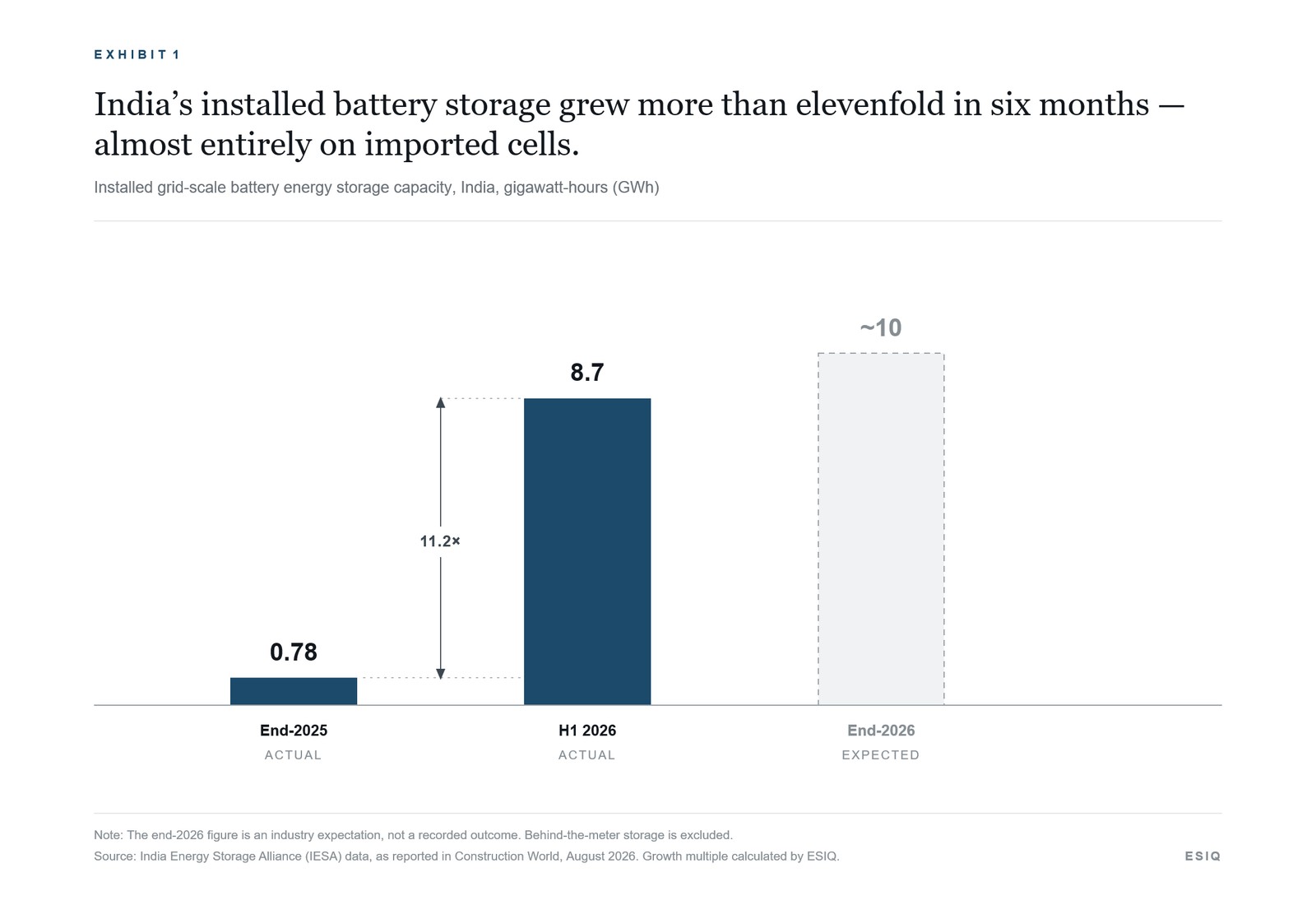
India’s grid-scale storage programme is expanding at the moment its supply base became more expensive. Installed capacity rose more than elevenfold in six months, almost entirely on imported cells, while lithium prices climbed and China began withdrawing export tax rebates on battery products.
The Ministry of Power’s response, issued on 24 December 2025, requires at least 20% of total project cost in storage procurement under the Viability Gap Funding Scheme to qualify as local content. This article reads that directive against the framework it applies, the arithmetic of the denominator it uses, and the two localisation instruments India already operates elsewhere in the same energy transition.
Four takeaways for market participants
India's 20% local content requirement for battery storage is the figure that applies automatically where a ministry has prescribed nothing higher. It records an absence of decision rather than a decision.
The threshold is measured against total project cost, not equipment cost – so engineering, civil works, installation and services all count toward it.
The directive names one component only: energy management software. Cells, cathode and anode are absent, so a project can comply using entirely imported batteries.
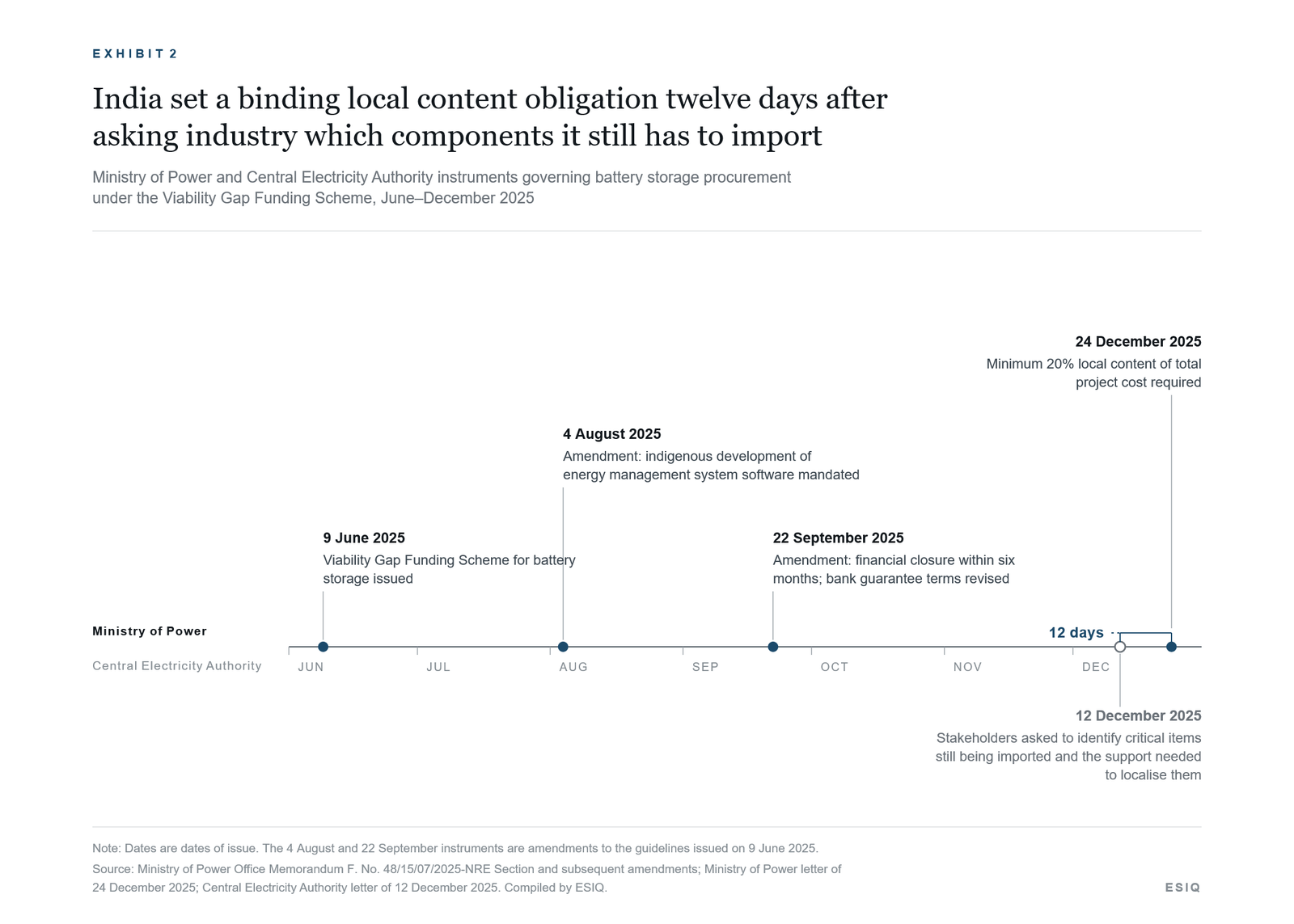
The rule was issued twelve days after the Central Electricity Authority asked industry which critical components India still has to import.
Why domestic manufacturing became urgent, and what India did about it
For a decade, the economics of grid-scale battery storage rested on one reliable assumption: cells would be cheaper next year than this year. Auction bids, subsidy schedules and national deployment targets were all built on that slope.
In late 2025 the slope reversed. Lithium carbonate prices climbed through the second half of the year, and China began the phased withdrawal of export tax rebates on battery products from April 2026, raising the landed cost of imported cells in India. Industry participants attributed rising costs to the loss of those export incentives and to higher prices for lithium, copper and aluminium; State Bank of India representatives reported that some funded projects had stalled as suppliers declined to honour earlier price commitments.
The consequences were immediate. Tariffs discovered in 2025 auctions had fallen to ₹1.48 lakh per megawatt per month for two-hour systems, against an indicative benchmark of ₹2.3 lakh, and roughly 75% of allocated two-hour capacity has since been assessed as financially at risk. Record-low bids had already raised concerns that some projects were economically unviable and could pose safety risks, with about 8 GWh of projects cancelled.
That story – cheap bids meeting expensive batteries – has been widely reported. It is not the subject of this article.
The more consequential question is what the reversal exposed. India’s storage programme is being built on imported cells at the moment the supplying country has begun raising their price and restricting their export. Installed capacity rose more than elevenfold, from 0.78 GWh at the end of 2025 to 8.7 GWh in the first half of 2026. Every gigawatt-hour added deepens a dependency that has just become materially more expensive.
Domestic manufacturing is the structural answer. On 24 December 2025, the Ministry of Power issued its response: a directive requiring that at least 20% of total project cost in battery storage procurement under the Viability Gap Funding Scheme qualify as local content, including inter alia the indigenously developed energy management system application software.
It was reported as a mandate. Read against the framework it applies, it is closer to a default.
A close reading of the letter, and of the framework it applies
The directive runs to two pages and seven short paragraphs, and it does not read like industrial policy.
It begins as a refusal. The opening paragraph records that the Ministry had received letters from States requesting an exemption from the Make in India Order for battery storage capacity under the scheme. The next notes that some States reported being advised, at a meeting of the PSDF Techno-Economic Sub-Group, to approach the Ministry for that exemption. The 20% requirement is not the opening move in a localisation strategy. It is the answer to a request to have no localisation requirement at all.
The third paragraph explains the number. Under the Make in India orders issued by the Department for Promotion of Industry and Internal Trade, and under Ministry of Power Order No. A-1/2021-FSC-Part (5) of 16 November 2021, certain power sector items with adequate domestic manufacturing capacity and competition have been notified for procurement exclusively from Class-I local suppliers. Battery energy storage is not on that list – and where an item has not been notified, both Class-I and Class-II suppliers may participate.
That sentence determines everything that follows. Paragraph 5 of the Make in India Order sets the thresholds – at least 50% local content for a Class-I supplier, at least 20% for Class-II – and then settles the matter:
“Nodal Ministry/Department may prescribe only a higher percentage of minimum local content requirement… For the items, for which Nodal Ministry/Department has not prescribed higher minimum local content notification under the Order, it shall be 50% and 20% for ‘Class-I local supplier’/‘Class-II local supplier’ respectively.”
Twenty percent, in other words, is what applies when a ministry has prescribed nothing. It is the residual value in the absence of a notification, not a threshold calibrated to any assessment of India’s battery manufacturing capability. And the Ministry’s discretion ran in one direction only: it could have required more, and could not have required less.
The fourth paragraph names the one component that must be Indian. It refers to the amendment of 4 August 2025, by which the Ministry mandated indigenous development of the energy management system application software for all storage capacity under the scheme. The fifth paragraph then folds that obligation into the local content requirement: States and procuring entities shall ensure a minimum local content of 20% of the total project cost, and this shall include, inter alia, the indigenously developed EMS application software.
Two features of that sentence do the work. The denominator is total project cost – not equipment cost, not battery cost. And inter aliameans “among other things”: the software is a required element of the 20%, not the whole of it. Cells are not mentioned. Cathode material is not mentioned. Anode material is not mentioned. The only component the directive specifically compels India to produce is a piece of control software.
Compliance for tenders already in the market is an undertaking. The sixth paragraph provides that where tenders were invited without specific mention of local content, States may obtain an undertaking from bidders and proceed with the award. Under the parent Order, local content is declared by the supplier itself, with a certificate from a statutory or cost auditor required for procurements above ₹10 crore.
And the sequence matters. Twelve days before the directive, on 12 December 2025, the Central Electricity Authority wrote to stakeholders asking them to identify critical items currently being imported and the support required for their localisation, observing that the power sector relies heavily on imported advanced components and is therefore exposed to supply-chain risk and price volatility.
Read together, the two letters describe a government that set a binding domestic content obligation twelve days after asking industry which components the country still has to import.
The arithmetic of a threshold measured against total project cost
A local content requirement is only as demanding as its denominator. The operative question is therefore not whether India can manufacture battery cells, but what proportion of an Indian storage project is already local before any manufacturing decision is taken.
Ember’s December 2025 assessment of utility-scale storage costs – drawing on recent auction results in Saudi Arabia, Italy and India together with developer interviews – puts the all-in capital cost of a large project in markets outside China and the United States at approximately $125 per kilowatt-hour. Of that, around $75 is core equipment shipped from China, and around $50 covers installation and grid connection. Within the imported equipment the split is sharply uneven: battery enclosures account for close to 90% of the core equipment cost, with the power conversion system and energy management system together making up around 10%.
Expressed as shares of total project cost, that produces three layers:
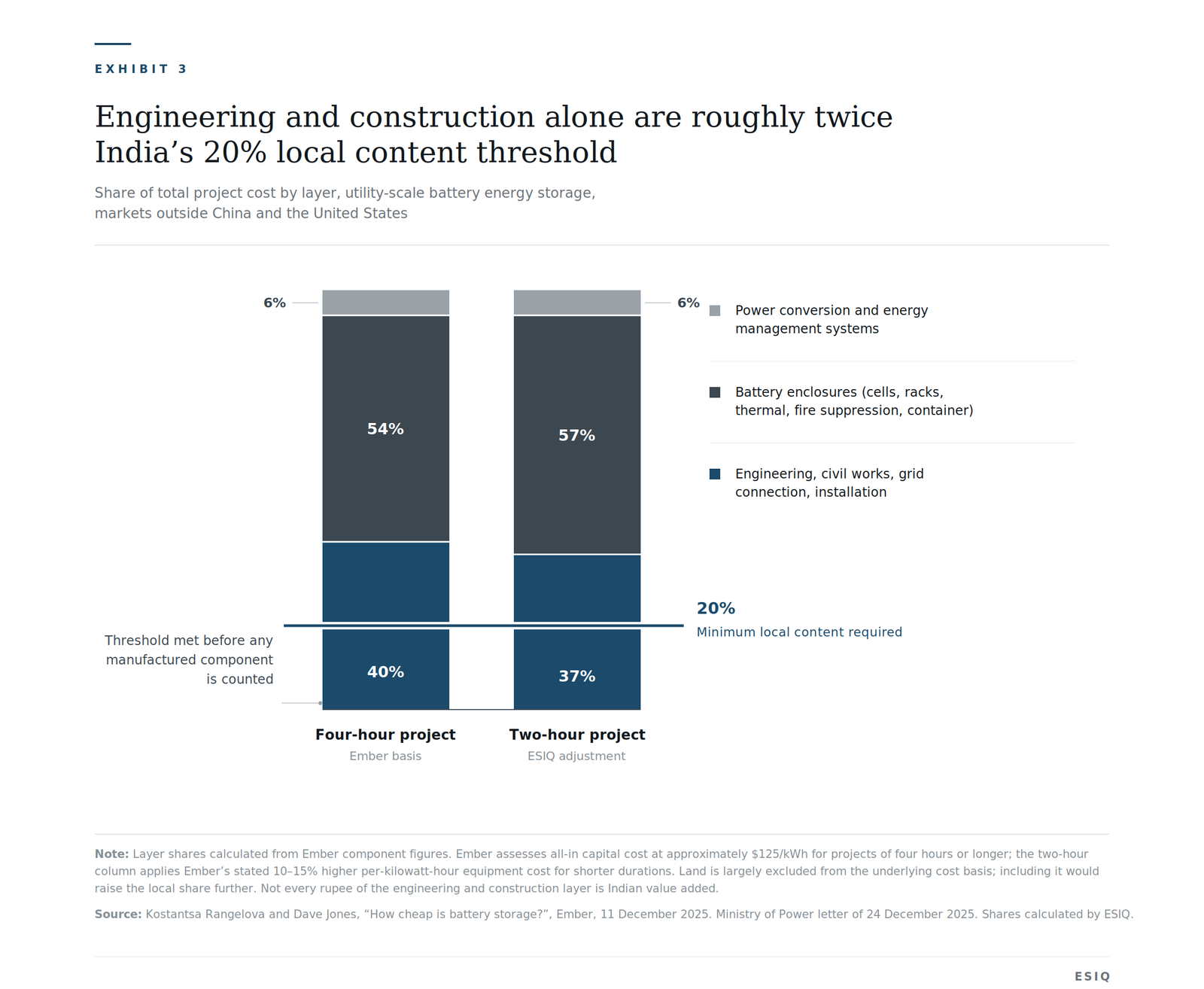
Ember states the conclusion directly: even when core equipment is imported, roughly 40% of total project value – about $50 per kilowatt-hour out of $125 – remains local through engineering, civil works, grid connection and other construction activity.
The Ministry requires 20%. The engineering and construction layer alone, in a project whose every manufactured component is imported, is approximately twice that.
The finding survives a conservative stress test. Ember’s figures describe projects of four hours or longer, whereas India’s tenders are predominantly two-hour systems, and Ember notes that equipment costs run 10–15% higher per kilowatt-hour at shorter durations because several components are sized to power rather than to energy. Applying that adjustment lifts total project cost to roughly $133–136 per kilowatt-hour and reduces the local engineering share to about 37% – still close to double the threshold. The adjustment also runs the other way: Ember assumes land is provided by the tendering utility or acquired cheaply, whereas the directive’s denominator is total project cost, which would ordinarily carry land, development and financing costs, all of them domestic.
The one component the directive names is the smallest layer in the project. Power conversion and energy management together represent roughly 6% of total project cost, and the software is a fraction of that. Ember records that in India, local power conversion and energy management prices are already competitive with Chinese equivalents. The single manufactured item the Ministry compelled India to produce domestically was one the Indian market was already supplying at a competitive price. The mandate followed the market rather than directing it.
What a binding rule would have had to reach is the 54% enclosure layer, where the import dependency sits and which the directive does not touch. At the 50% Class-I threshold, a developer could no longer clear the requirement on engineering and construction alone; a material share of the enclosure layer would have to be domestic. That is the arithmetic difference between a procurement formality and an industrial instrument – and the Ministry had the authority to choose it.
Local content is defined as value added in India, and not every rupee of the engineering and construction layer qualifies: transformers, switchgear and high-voltage cabling within that layer may themselves be imported. This analysis establishes the order of magnitude of the non-manufacturing share, not a certified compliance figure for any individual project.
Assembly is not manufacture, and the directive does not distinguish between them
India’s advanced chemistry cell battery demand stood at 28 GWh in 2025, split roughly 60% to electric vehicles and 40% to stationary and grid storage, according to India Energy Storage Alliance data. A projection by the Institute for Energy Economics and Financial Analysis and JMK Research puts demand at approximately 272 GWh by financial year 2030.
Against that, the Advanced Chemistry Cell Production Linked Incentive Scheme – launched in October 2021 with an outlay of ₹181 billion and a target of 50 GWh of domestic cell capacity by 2025 – had seen 2.8% of that target, or 1.4 GWh, commissioned within the stipulated timeline as of October 2025, entirely by a single company. Against an estimated 1.03 million jobs, it had generated 1,118. Against ₹112.5 billion of targeted investment, roughly ₹28.7 billion had been committed. One beneficiary withdrew from a 20 GWh allocation entirely, and as of February 2026 no incentive had been disbursed to any beneficiary.
The distinction that matters is between assembly and manufacture. India has roughly 60 GWh of installed capacity for assembling battery packs. Its commissioned cell manufacturing capacity is little more than 1 GWh.
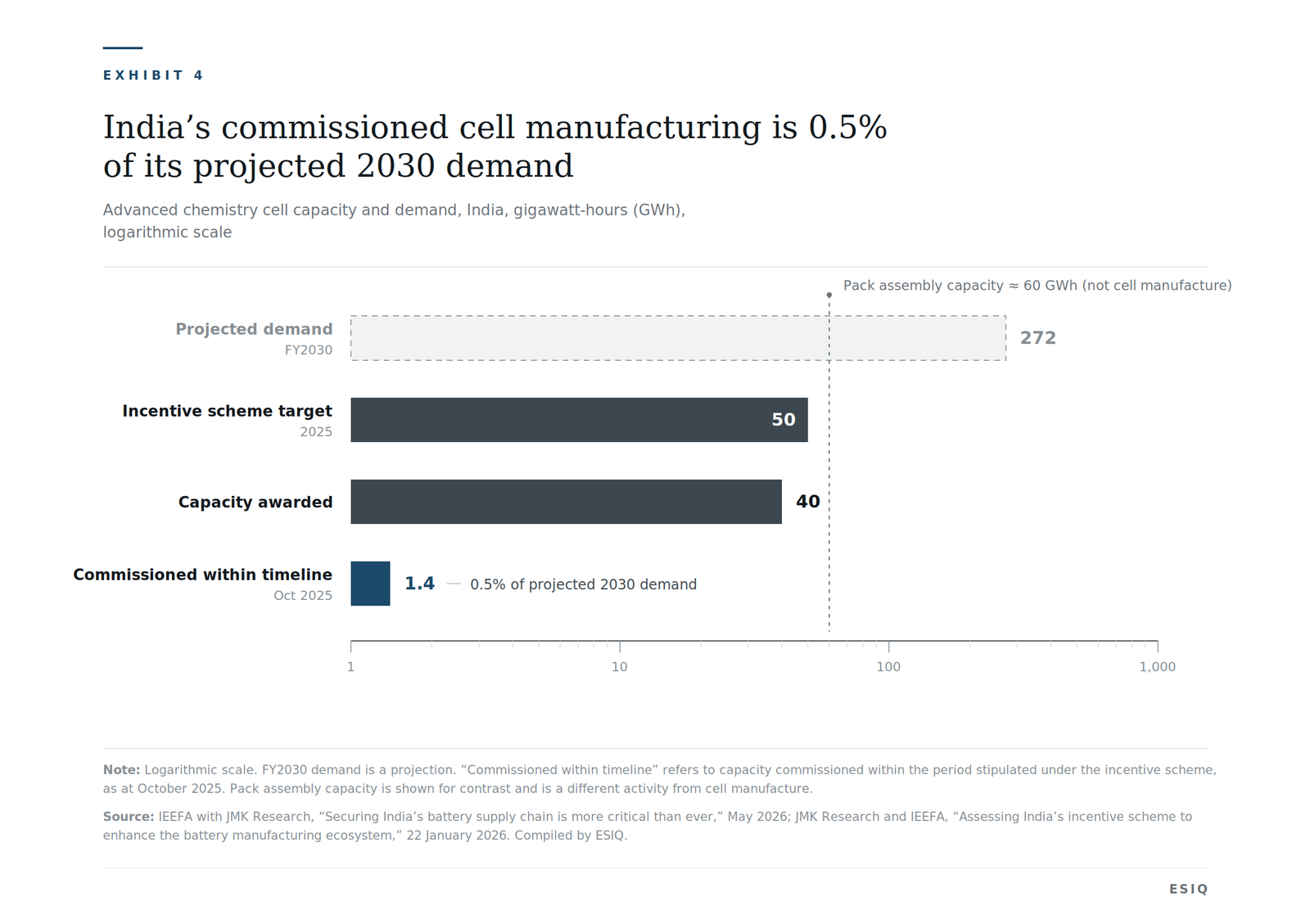
Those two numbers describe the same industry doing two very different things. Pack assembly takes imported cells and builds them into modules, racks and enclosures. It employs Indian workers, occupies Indian factories, and constitutes genuine domestic value addition under the Make in India formula. It also leaves the import dependency entirely intact.
This is the previous section’s argument repeating one layer up. The engineering and construction layer is local without being manufacturing. The pack assembly layer is manufacturing without being cell production. A local content rule measured on total project cost, and silent on which components must be domestic, can be satisfied from both – while the cell, the cathode and the anode remain imported.
The scale of what remains imported is considerable. Around 75% of lithium-ion batteries used in battery electric vehicles in India come predominantly from China, and the import bill has risen eightfold, from $384 million in 2019 to over $3 billion in financial year 2025. At current cell prices of roughly $85 per kilowatt-hour, meeting 272 GWh of demand by financial year 2030 without domestic cell output implies an annual battery import bill exceeding $23 billion – against an Indian crude oil import bill of roughly $130–140 billion a year. The risk is that India’s effort to reduce oil import dependence quietly substitutes an equivalent dependence on foreign battery cells.
The same government has, moreover, already written a more demanding standard for this exact dependency. In July 2026 the Ministry of Heavy Industries tendered 10 GWh of advanced chemistry cell manufacturing capacity dedicated to grid-scale stationary storage, requiring bidders to commit to at least 25% domestic value addition within two years and at least 40% within five. The scheme aimed at building cell capacity escalates and specifies the cell. The rule governing where public money is actually spent on storage does neither.
Two working localisation instruments, neither applied to battery storage
The question is not whether India is capable of writing a demanding domestic content requirement. It has two in operation, in adjacent parts of the same energy transition.
The first is the Approved List of Models and Manufacturers, India’s solar localisation framework. Introduced in 2019 and applied to modules from 2021, it works by naming components rather than setting a percentage of project cost: government-supported projects must draw modules from List-I, the cells within those modules from List-II, and – from 1 June 2028 – the wafers within those cells from List-III.
Three features distinguish it from the battery directive. It escalates upstream on published dates, each tier announced years in advance with defined grandfathering for projects already bid. It is chained: a module manufacturer’s listing depends on the cells and wafers it uses being themselves enlisted, so compliance cannot be satisfied at one tier while the tier above remains imported. And it contains an ownership test: the wafer list will not be issued unless it includes at least three manufacturing units operating independently and not under common ownership or control, with aggregate capacity of at least 15 GW per year.
It has also held under pressure. As the cell deadline approached, Indian module manufacturing capacity stood at roughly 193 GW against domestic cell capacity of about 31 GW – a gap sharper still in TOPCon technology, where approved module capacity of nearly 172 GW faced domestic cell capacity of around 10 GW. Manufacturers warned of production disruption and stranded investment. On 25 May 2026 the Ministry of New and Renewable Energy confirmed that the 1 June 2026 deadline would not be extended.
That is what a binding localisation instrument looks like when the domestic supply base is demonstrably inadequate. The Ministry did not lower the requirement. It kept the date, and let the gap become the industry’s problem to solve.
The second instrument belongs to the Ministry of Power itself. On 30 April 2026 – four months after the battery directive – it revised the minimum local content requirement for high-voltage direct current substations of the line-commutated converter type, under the same power sector Make in India framework. It replaced a uniform 60% requirement with a dated path: 30% to 31 March 2028, 40% to 31 March 2030, 50% to 31 March 2032, and 60% to 31 March 2035.
The logic of a phased path is that domestic industry needs time to build capability in a complex, import-dependent technology. That is precisely the situation of battery cells. The Ministry’s answer for high-voltage direct current was not to abandon the requirement, but to publish a trajectory toward it.
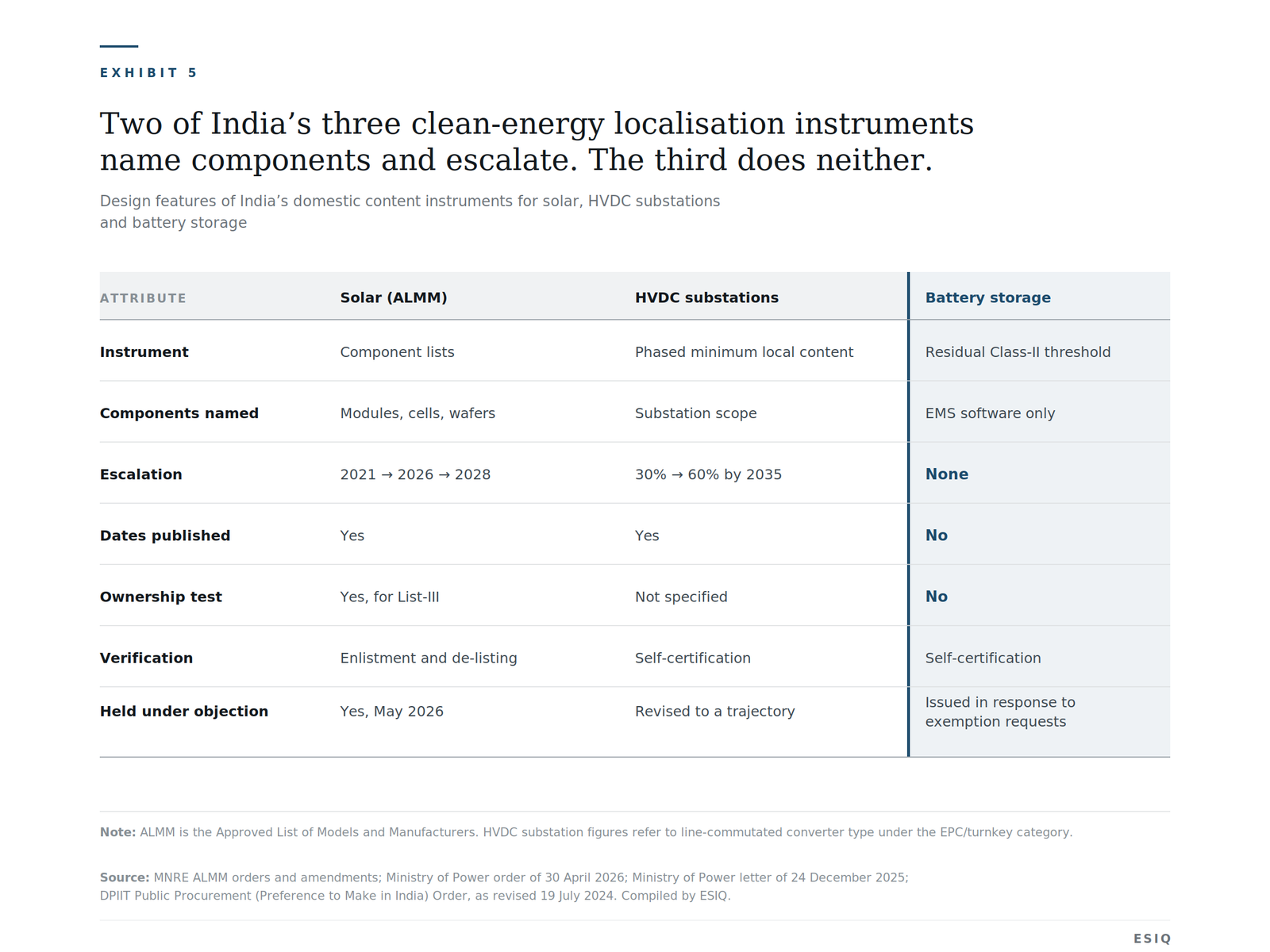
Three instruments, two ministries, one energy transition. Two of them name components, publish dates and escalate. The third does none of these things.
Nor are the regimes distant from one another. The Ministry of New and Renewable Energy clarified in July 2025 that whether solar cells feeding a storage project must comply with the Approved List depends on that storage project’s own exemption status – so a solar plant charging an exempt battery inherits the exemption. The localisation perimeter around India’s solar supply chain already has a battery-shaped opening in it.
Implications for developers, suppliers and policymakers
For developers
The immediate compliance burden is modest. A project whose every manufactured component is imported will clear 20% from engineering and construction alone, and where tenders were invited without a local content clause, an undertaking from the bidder suffices.
The exposure is not compliance. It is revision. India’s solar framework moved from modules to cells in five years, and from cells to wafers in two more, on dates published well in advance; the Ministry of Power published a nine-year path for high-voltage direct current in April 2026. Battery storage is the only one of the three with no published trajectory at all – and long-duration contracts priced today implicitly assume it will stay that way.
The question worth modelling is therefore not whether today’s requirement can be met, but what a component-specific requirement arriving in 2028 or 2030 would do to a portfolio procured on today’s assumptions, and whether existing contracts allocate that risk to anyone at all. A second exposure sits alongside it: clearing the threshold offers no protection against the cell price movement that made localisation urgent, because the threshold can be satisfied without touching the cell.
For suppliers and manufacturers
A threshold that can be met from civil works and pack assembly creates no demand signal for domestic cell production. This is the structural asymmetry in India’s current approach: the incentive scheme gives manufacturers a reason to build cell capacity, while the procurement directive gives them no guaranteed buyer for its output.
Solar shows the alternative. There, the Approved List converted a manufacturing ambition into enforceable offtake – government-supported projects must use listed cells, so building listed cell capacity has a market attached to it. For anyone weighing an investment in Indian cell manufacturing, the difference is material. The incentive scheme has delivered 1.4 GWh against a 50 GWh target; a demand-side requirement is the instrument that has worked elsewhere in India’s energy transition.
For policymakers
The instruments already exist, are drafted, and are in current use within the same government. Applying one to battery storage would require no new legal architecture – only a notification under an order that has been in force since 2017.
Three design choices distinguish the working instruments from the directive: they name components or a defined scope rather than setting a percentage of total project cost; they escalate on published dates, so industry can plan against them; and, in the case of solar, compliance is verified by enlistment rather than by self-declaration.
The sequencing question is separate, and more uncomfortable. A supply-base assessment is not a precondition anyone should need to argue for. It is, however, the thing that determines whether a threshold is demanding, achievable, or – as here – already satisfied before it is imposed.
ANI. (2026, May 2). Govt eases Make in India norms for HVDC substations, targets 60% local content by 2035. ANI News.
Business Today. (2026, May 19). Why lower standalone battery storage tariffs pose viability risk.
Central Electricity Authority. (2025, December 12). Identified critical items currently being imported and support required for their localization [Letter]. Government of India.
Construction World. (2026, August). India battery storage tariffs seen rising as costs squeeze projects.
Department for Promotion of Industry and Internal Trade. (2024, July 19). Public Procurement (Preference to Make in India) Order, 2017, as revised. Ministry of Commerce and Industry, Government of India.
Down To Earth. (2026, June 3). India's solar ambitions face a factory-floor test: Rollout of new rules sparks industry concerns over domestic cell shortage, stranded investments.
ESS News. (2026, July 17). India launches tender for 10 GWh battery cell manufacturing capacity for grid storage.
Garg, D. (2026, May). Securing India's battery supply chain is more critical than ever. Institute for Energy Economics and Financial Analysis.
GreentechLead. (2026, May 26). India's energy storage boom faces financial crisis as aggressive bidding threatens renewable grid expansion.
JMK Research & Analytics, & Institute for Energy Economics and Financial Analysis. (2026, January 22). Assessing India's incentive scheme to enhance the battery manufacturing ecosystem.
Mercom India. (2025). Solar cell capacity under MNRE's ALMM List-II rises to 18.5 GW.
Mercom India. (2026, May). Solar cell capacity under ALMM List-II nears 30 GW.
Ministry of New and Renewable Energy. (2026, January). Policy & regulatory updates: December 2025. Government of India.
Ministry of Power. (2025). Viability Gap Funding Scheme for development of Battery Energy Storage Systems supported through the Power System Development Fund [Office Memorandum F. No. 48/15/07/2025-NRE Section, 9 June 2025, with amendments of 4 August and 22 September 2025]. Government of India.
Ministry of Power. (2025, December 24). Public Procurement (Preference to Make in India) to provide for purchase preference (linked with local content) in respect of implementation of Battery Energy Storage System (BESS) under VGF Scheme supported through PSDF [Letter signed by S. K. Sharma, Director (NRE/RCM)]. Government of India.
OPIS. (2026, March). India extends solar ALMM framework to ingots and wafers.
Rangelova, K., & Jones, D. (2025, December 11). How cheap is battery storage? Ember.
Reuters. (2025, December 9). India's record-low battery storage bids raise concerns over project viability. Republished by MarketScreener.
All sources accessed September 2026. Figures are reported as stated in the underlying sources; percentage shares, adjustments and multiples attributed to ESIQ are ESIQ calculations from those figures.
Where public documents stop
This article has been built entirely from public documents. That was deliberate, and it also marks the limit of what public documents can establish. Three questions remain, and none of them can be answered from policy texts.
Which suppliers stand behind India's awarded storage capacity?
The cost structure of those projects is knowable in aggregate; the companies supplying their cells, power conversion equipment and enclosures are not systematically recorded anywhere public. Without that map, no one can say how concentrated India's storage pipeline is on a small number of foreign suppliers – or what a future component-specific requirement would actually disqualify.
What is the real local content of a given project?
The analysis above establishes the order of magnitude. It cannot establish a project-level figure, because not every rupee of the engineering and construction layer is Indian value added. Answering that requires tracing components to manufacturers, and manufacturers to their ultimate owners.
Where, node by node, does India's supply base actually exist?
The gap between roughly 60 GWh of pack assembly and little more than 1 GWh of cell manufacturing is the single most consequential fact in this analysis. It is also the clearest illustration of why aggregate capacity figures mislead: the same industry, counted at two different points in the value chain, produces two irreconcilable pictures of India's readiness.
ESIQ maintains a structured market intelligence database covering the battery energy storage value chain, built on 49 controlled value-chain node classifications and a 39-chemistry taxonomy across 12 families, with ownership and corporate control recorded at entity level. It is designed for exactly these questions: not how large a market will become, but who occupies which position within it, and who ultimately controls them.
We work with developers assessing supplier exposure, manufacturers evaluating where domestic capacity is genuinely absent, and institutions that need a defensible view of a supply chain rather than a forecast of its size.
A supplier-level analysis of India’s awarded storage pipeline is in preparation. To discuss it, or any bespoke research question, contact ESIQ.
Mapping your storage supply chain?
ESIQ works with developers, manufacturers and institutions that need a defensible view of a supply chain rather than a forecast of its size.
Continue the research
The Battery Fix
How battery storage is solving the energy transition's real bottleneck by moving from passive storage to grid support, stability and renewable-heavy power systems.
Read More →
When Power Prices Go Negative
How AI can help turn periods of electricity oversupply, negative power prices and grid imbalance into operational and market opportunities.
Read More →
From Ambition to Market Reality: Where Could India's Green Hydrogen Opportunity Emerge?
A scenario-based view of India's green hydrogen opportunity across demand, supply, sector adoption and the emerging market gap.
Read More →